
 Raheim:
Let's start with some general information about you. Who are you
and what inspired you to become a [Nichiren] Buddhist?
Raheim:
Let's start with some general information about you. Who are you
and what inspired you to become a [Nichiren] Buddhist?
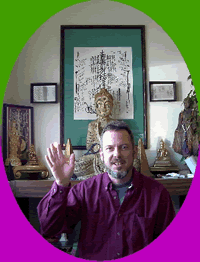
Don: My name is Don Ross and I've been chanting the Daimoku of the Lotus Sutra since 1984. Chanting and practicing Buddhism in NSA/SGI helped me to heal my fractured mind. In the early 1980s, when I was 19 years old, before I became a buddhist, I shot up a lot of speed and fried my brain like bacon and eggs. I then spent several years in the mental health system and it was then that I took up the practice. For the first time, this past year I put down in writing my three year sojourn through schizophrenia. It was cathartic. If anyone is interested, it is called, Adventures in Consciousness, from Baptist to Buddhist and the Beyond; or, Tales of a Spiritual Deviant.
Raheim: Many know you from your provocative website, LotusSutra.net. On it, you published a letter about deciding to leave SGI-USA dead link, then becoming an "Independent non-sectarian Buddhist". What motivated you to do this?
Don: Provocative? Thank you! As for the SGI, after spending the entire 1990s devoted to understanding the conflict between the Soka Gakkai and Nichiren Shoshu by building bridges of friendship and understanding between SGI-USA, the Nichiren Shoshu Hokkeo and those who claim Independence of all sectarian strife, I came to the conclusion that the SGI was fundamentally unreformable, neither from within nor from without, at least not in the short term.
Furthermore, as I looked at Nichiren's writings, minus the filter of the NSIC [Nichiren Shoshu International Center] footnotes, I discovered I fundamentally disagreed with much of the philosophical basis which the SGI inherited from Taisekiji, in particular the views of Nichiren as the True Buddha, as taught by the 26th High Priest of Taisekiji, and the Plank Mandala known as the DaiGohonzon which was first proclaimed by the 9th HP of Taisekiji. Considering all the evidence available to me, it seems these are at best myths, invented to increase the prestige of a small backwater sect at the foot of Mount Fuji. If one builds a castle upon a flimsy foundation, how long will the castle stand? Thus, it was this dual realization which occured and sent me towards the exit door.
As for my proclamation of Independence from any sect, I believe it is important for a person to take a breather in between sectarian affiliations. It is not healthy to jump from sect to sect, searching for the One True Teaching. Such an approach can only lead to suffering. Instead, I advocate that people look at all their options; to look into the chasm before they take that leap of faith. It is in this sense that I view the Independent Movement, as a sort of bardo state; at least that is how it was for me.
However, once I realized (in 2001) that no one or thing can ever truly be "independent" of anything else, i.e., once I understood the interconnected nature of all phenomena, I stopped using "Independent" as a self-label. Instead, I added a single syllable and have since called myself an Interdependent Buddhist, or perhaps as Independent-minded, meaning that even though I am no longer a nonsectarian, I support the Independent Movement in thought, word, and deed.
Raheim: Presently, you are a member of both Nichiren Shu and Reiyukai. What caused you to join them? And what do you find in both sects that the Soka Gakkai does not fulfill?
Don: Once I left the Gakkai, I decided that I would remain Independent for at least one year, as a necessary detox period. Around that time, I became close friends with Ryuei dead link, who was then a shami (acolyte) with Nichiren Shu. After more than a year of delightful telephone conversations with him, I arranged to Take Refuge in the Buddha, Dharma, and Sangha on 9/1/01 in San Francisco, when I was visiting my family in northern California. Joining Nichiren Shu was almost a side thought; however, I maintain my affiliation with Nichiren Shu as a simple statement of public support for the Rev. Ryuei. Although with my reputation, this may or may not be a good thing for him. (smile)
My affilliation with Reiyukai dead link is much more recent. Finally, after four years of practice on my own in San Diego, some 500 miles from the temple I have joined, I decided to take my own advice. I went out and found whatever happened to be around and am checking them out with my own eyes and ears, not accepting rumor, only actual experience. On the surface, Reiyukai is barely Buddhist. All faiths are welcome. Instead, they are an association of people who venerate their ancestors by chanting/reading portions of the Threefold Lotus Sutra in one's native language. As a family historian since the age of 13, I find it fascinating to integrate these two interests into a philosophy and onto my altar with the addition of an ancestral tablet.
Finally, to answer the last part of your question, in May 2001 the SGI-San Diego leadership asked me to stay away from all local SGI activities, whether at their community center or in people's homes. They made it very clear to me that they do not want their members to realize that there is a world outside of the SGI. After some discussion by telephone, I decided to honor their request.
To my knowledge, this general ban is limited only to San Diego. I am still openly welcome at SGI meetings in northern California (in the Redwood Empire) where I spent the first 15 years of my practice.
Raheim: Can you be more specific as to where you believe the Soka Gakkai is in need of reform?
Don: No, not at this time. Even though it has only been four years since I left the Gakkai, it feels like a lifetime ago. The SGI is going to be what it is making the causes to be. I am no longer a member of that organization and so I do not believe it is my place to talk about its many faults (excepts perhaps as it has affected me). However, if you want a full answer as to what I saw wrong with the Gakkai, anyone can search the IRG archives for my username CampRoss in 1999, the year I gave "reform" one last try.
Raheim: What made you resort to a "one last try" to reform SGI. Did you feel any hope that the organization would change in one form or another?
Don: Sure, without hope, why try at all? When the temple issue first erupted, one third of my district went over to the temple and then went Independent (the very beginning of what is now known as the Independent Movement). I was forced to choose sides early on. After reading every word that Nichiren Shoshu and the SGI was printing about the other, my parnter Wes Geotzel, who has since died of AIDS, and I decided that we would devote one decade to the temple issue and the SGI, since we believed that the SGI had the greatest potential for self-reform. The full story of my early experiences interacting with Nichiren Shoshu and Independent members in my SGI district can be found online.
Years later, in 1999 at the encouragement of a friend, I got involved in IRG to try to reform the SGI-USA at the national level. My experience has shown me that this is where the problem lies, at the very top. Because I got involved with IRG, I was blacklisted by my local Gakkai leaders, put on their list as the leader of the local Nichiren Shoshu Hokkeko. Anyone who knows me knows how laughable this is. I have always been loudest when criticizing the doctrines of Nichiren Shoshu, as can be seen in my letter of resignation.
What is not funny is that I was put on that list by people who knew better, people whom I once called friends. So, no, I no longer believe that SGI is fundamentally reformable, at least not to the degree I need for my personal spiritual affiliation, and probably not for another 20 or 30 years or more. Perhaps next lifetime I will check them out again.
Raheim: To get straight to the point, the most provocative content in your website are the numerous honzons and Gohonzons that have come down from the Nichiren Tradition. Some say that you acquired them from a book or the ill-reputed Bruce Maltz. How did you acquire these images? And why did you publish them? What do you really wish to prove/accomplish by distributing them in the internet?
Don: All roads lead to Bruce Maltz. The first copies I acquired of most of the Great Mandalas found in the Gohonzon Shu were photocopies of photocopies of photocopies which had been passed from various individuals in the USA, the original of which probably came from Bruce years before. (He, not I, was the first person to long ago put a few Nichiren Gohonzons online.) By the end of that same year (1999), I received my own copy of the Gohonzon Shu published by Rissho Ankoku Kai in 1947-49, obtained for me (and a few others) by Bruce while he was living in Japan. It is a silk box containing the authenticated lithographs as found on my website, with an accompanying book in Japanese that explains each Mandala.
While searching for this collection on- and off-line, I also researched Japanese copyright law and discovered something truly marvelous: the book's copyright had just expired that very same year. Thus I could put the entire collection online legally, with respective explanations, for all the world to see and learn. Still, the explanations are all in Japanese, but one day I hope someone will volunteer to translate this treasure trove of knowledge.
The biggest reason, though, that I put the Mandalas online is because people were asking for them. I didn't want to put myself in the same intermediary position that the sects had become. After talking with friends, I decided it was time to set the Gohonzon Mandalas of the Nichiren Traditions free, to not allow any sect to control its bestowal with an iron fist ever again. I cannot even begin to tell you how many stories I have heard, particularly from divorcees, who were denied Gohonzon unless their life conformed to the organization's standards. This common manipulation of the Great Mandala as a means for coercion was not acceptable to me, and so I did what I was able. One person can make a difference.
One last point I would like to clarify which is often confused is concerning the origin of the modern spread of the Great Mandala known as the Prayer Gohonzon dead link. I was the first to mass-produce it for use by the Independent Movement and others. While it can be found in the Gohonzon Shu, it was not copied from it. Rather, I received mine from Bruce Maltz, then of Kempon Hokke, with the assistance of Carmen of the Independent Movement, from a certain Nichiren Shu priest in Japan who wishes to remain anonymous.
I was allowed to have one, even though I was still an SGI member, because of the special inscription on this particular Mandala. The top characters in the right corner begin: "This sutra is truly a splendid medicine for the diseases of the people of Jambudvipa. A sick person who hears this will be immediately cured of his disease. He will not grow old or die before his time...." I received it in June 1999, the third household outside of Japan to receive one (the Maltz's, and then Carmen & Tami, one day before me). By the end of the year, I resigned from SGI-USA and had 1000 Prayer Gohonzons lithographed to commemorate the event. (One day soon, I intend to write in detail about my spiritual transformation, but not here....) These lithographs have all now been dispersed to the Four Winds, crossing nearly all sectarian bounds outside of Japan, to at least five continents. And now others, not I, continue to reproduce them for Independent Buddhists.
Raheim: You wrote above that you put the Mandalas online because people were asking for them. To whom, specifically, are you refering? SGI members? Independents?
Don: Yes, mostly SGI members and Independent Buddhists, but there were (and are) many others who seek them. My concern though, at least at first, were the SGI members because at that time, it was not possible as an SGI member to receive an actual Nichiren Mandala. Thus I was the first stone to be tossed into the pond and because of me, hundreds, if not thousands of SGI members have received or printed their own. This is why SGI-USA has changed their bylaws in response to my activities. This just goes to show that even someone on the outside of the org can, under the right circumstances, affect change in their inner circle. It may not be a desirable change, but it is change nevertheless.
Raheim: Many know the Gohonzon as the absolute object of fundamental respect. Many also believe that reproducing them out of an organized sect or group constitutes great slander. How do you view the Gohonzon -- not in its spiritual innate essence, but in its physical form of a scroll or wooden reproduction? And how do you relate these views to the manner by which you display them in your website?
Don: While I respect people's right to believe in their own superiority, I am no longer so inclined to buy into the superstition. To those who say the Gohonzon is the true object of worship, if it seems they are refering to the object itself, I simply say it is nothing but a piece of paper. To those who say the Gohonzon can only be a scroll-type Mandala, I smile and say yes, if that is what you like, but I prefer to use a combination of icons to represent the Ceremony in the Sky. If someone says that only one certain kind of Gohonzon is acceptable, I laugh and respond by saying, yes, if you practice in a sect, it is best to chant to the Mandala of the Sangha's choice. Any other choice is likely to breed suffering and should be made only after the most careful consideration of all possible consequences.
From yet another perspective, I believe that in the early 1990s, the SGI created the philosophical foundation for the widespread dispersal of the Great Mandala by a lay organization. What I did was simply to take their logic to its furthest extreme, removing even the need for an organization, putting all of Nichiren's Great Mandalas into the hands of the People. This, to some, is my gravest slander. Does anyone else remember hearing the countless times Nichiren Shoshu has said the same of the Soka Gakkai, for this same "heresy"? It is perfectly understandable coming from Nichiren Shoshu, but from Soka Gakkai members? How can one keep a straight face at such a two-faced view?
Raheim: In your website, you've combined various forms of Buddhism as recorded by your travels to visit various Buddhist sects. How has your health been as far as traveling and the like? The way you've associated yourself with other Buddhist sects is something that many Nichiren Buddhists quote and say to be a heretical act. How do you feel about this?
Don: First of all, I rarely travel purely to seek Buddhism. I am not a professional religionist. I travel to visit my family and sometimes for fun. When I am able, I also like to visit friends and to attend a variety of buddhist activities.
Heresy is an interesting topic. It is a useful tool for social and behavioral control.
The year I left the org, in 1999, was the worst my health has been since the time I was in a coma, two decades ago (see the Geocities link above). I quit smoking cigarettes and the Gakkai in the same year. I was diagnosed with Wasting Syndrome. I became skin and bones. By the next year, not only had I put on more weight again, but my immune system became "normal". After a decade of a weakening body, I was at last successful in repairing my damaged immune system. Since that time, my immune system has continued to be in the normal range with the virus (more or less) under control. This does not mean I am cured, nor does it mean I am completely healthy, but for being HIV infected for over 20 years, with an AIDS diagnosis for 10 years, I am doing amazingly well.
Now, if I were the superstitious type, I would encourage people to run and not walk from the SGI. I realized that the years I actively practiced in the org, my immune system continued a steady decline. The years when I stayed away, either by choice or several banishments, my health was strong and supple. However, I am not a superstitious type, and so, even after my many bad experiences with them, I tell people that if they are interested in Nichiren Buddhism, then at the very least, they should attend an SGI meeting or two, so they know what they are about. And since all sanghas vary, if they find a group they like, to stick with them.
Raheim: Buddhism in general advocates individual happiness and social equality. As a homosexual, how do you relate your lifestyle to the concept of an "all-inclusive" religion? Do you feel that you are pursuing this by having a multi-cultural take on Buddhism?
Don: Perhaps, but my religion has very little to do with my sexuality. I see little to no connection between my sexuality and an "all-inclusive" religion, except perhaps, I won't pray with homophobes. For them, yes; with them, doubtfully. My path of exploring a multi-cultural approach to Buddhism has more to do with where I have lived my entire life, on the California coast where all of the world's cultures mix and mingle. It may also be a way of following in the path of my gr-gr-gr-grandfather, the Rajah Ram Mohun Roy dead link, who established the first non-sectarian non-caste-based religion in modern India.
Raheim: Several years after leaving the SGI-USA, I assume that you've learned many things that pertain to Buddhism and life in general. Could you summarize what you have learned and how it is relevant to other seekers out there?
Don: Keep an open heart and an engaged mind. Do not leave your common sense or your humor at the door. Few religions are intrinsically good or evil; all fall somewhere in between. Even the religions that have been labeled as cults are not all bad. In fact, some groups are quite interesting with their respective fruits and nuts.
Namu Myoho Renge Kyo, Namas Shakyamuni Buddha,
Don Ross, an Interdependent Buddhist